
What the data says about demand
Two populations matter for a senior project in Costa Rica: Costa Ricans themselves, and North American retirees who move or spend winters here. Both are aging quickly, according to official statistics.
- Costa Rica. The national statistics institute, INEC, reports in its Panorama demográfico 2023 that people aged 65 and over went from 5.8% of the population in 2003 to 10.6% in 2023, and are projected to reach 14.4% in 2030. In absolute terms, the group grows from 546,225 people in 2023 to a projected 1,455,213 in 2053. Life expectancy at birth is projected to rise from 80.8 years in 2023 to 84.3 years in 2050.
- United States. The US Census Bureau counted 55.8 million people aged 65 and over in 2020, 16.8% of the population, up 38.6% from 2010, the fastest growth for that group since 1880 to 1890.
- Costa Rica as a destination. International Living's Global Retirement Index 2026 placed Costa Rica third, as reported by The Tico Times.
These figures describe demographic pressure, not demand for a specific project. A feasibility study should still test pricing, care needs, staffing and competition in the area you choose.
Three product types, three sets of rules
| Format | What it offers | Main approvals to plan for |
|---|---|---|
| Independent living community | Homes or lots for active retirees, with shared amenities | Land use, subdivision or condominium rules, municipal building permits |
| Long-stay home (hogar de larga estancia) | Residence with daily care and supervision | All of the above, plus licensing (habilitación) by the Ministerio de Salud |
| Day center or mixed campus | Daytime care, or independent homes next to a care building | Licensing for the care services, plus the permits for each building |
The line that changes everything is care. Once a project provides care services to older adults, it enters the Ministry of Health's licensing regime described below.
Licensing: Ministerio de Salud and CONAPAM
The Ley Integral para la Persona Adulta Mayor (Ley 7935) defines an older adult as a person aged 65 or over, and created CONAPAM, the national council for older persons. Its article 54 requires public, private and mixed establishments that intend to provide care services to older adults to be licensed (habilitarse) by the Ministerio de Salud.
For residential care, the specific rule is the Norma para la habilitación de Hogares de Larga Estancia for the comprehensive care of older adults, Decreto 44730-S of October 2024, which CONAPAM lists in its legal framework. In 2026 the Ministry opened a public consultation on a reform of that decree and on a proposed accreditation norm for long-stay homes. Read the version in force when you design, and have a local consultant check the building program against it before the architect finishes the plans.
What the land needs
- Hospital access. Measure drive times to the nearest CCSS hospital and to private hospitals, at the hours residents and families will travel.
- Airport access. Families and international residents value a short, predictable drive to the airport.
- Gentle ground. Older residents need short, level walking routes; steep sites add cost for ramps, retaining walls and drainage.
- Water. Confirm the source: a public provider's availability letter, or wells with the Dirección de Agua permits that the groundwater procedures describe.
- Electricity. Check capacity for a care building, kitchens and laundry, not only for houses.
- Land use and environment. Get the municipal land-use certificate for the intended use. SETENA's guidance says buildings over 1,000 m² must file a D1 environmental form.
- Rivers and trees. The Ley Forestal protects strips along riverbanks and bans cutting trees in them, which shapes the buildable area.
- Staff. Care homes need nurses, aides and cooks who live within commuting distance.
A site to evaluate: Finca Valle Verde in Atenas
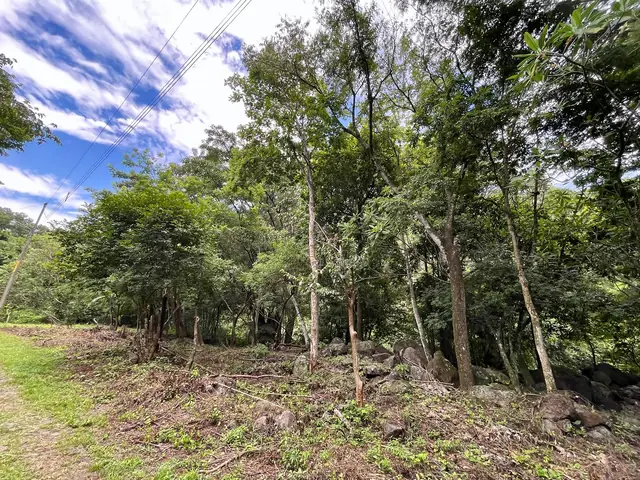
Finca Valle Verde, in Concepción de Atenas, Alajuela, offers about 5.2 hectares (12.9 acres) in seven titled lots, from 7,000 to 9,254 m² each. Several lots are neighbours, and two border the Río Grande. The property already has a gated main entrance, internal cobbled and paved roads with gutters, electricity with street lighting, its own well with piping and laboratory analysis of the water, mature trees and forest.
By car without traffic, the Hospital San Rafael de Alajuela (CCSS) is 19 to 33 minutes away, a private hospital in Escazú 27 to 31 minutes, Juan Santamaría International Airport 21 to 31 minutes, and San José 34 to 40 minutes. The national weather institute describes the lower western Central Valley, where Atenas lies, as having a dry climate with a marked Pacific influence.
What we do not state on this site: land use for a care facility, utility connections for each lot, and which lots are available and on what terms. Ask us, and confirm land use with the municipality. See the retirement community land page and the information for developers.
Due diligence for a developer, step by step
- Define the format: independent living, long-stay home or a mix.
- Check title, survey plans and liens for every lot at the Registro Nacional.
- Request the land-use certificate for the specific use.
- Map river protection strips and slopes, and calculate the real buildable area.
- Confirm water and electricity capacity for the full program.
- Review the current Ministry of Health norm with a local consultant.
- Run the environmental screening with SETENA's thresholds in mind.
- Test the market: prices, care levels, staffing and the families you will serve.
For the resident side of this market, see our guide to assisted living in Costa Rica.
Sources
- INEC: Panorama demográfico 2023
- US Census Bureau: older population, 2020 Census
- Ley 7935, Ley Integral para la Persona Adulta Mayor (SCIJ)
- Norma para la habilitación de Hogares de Larga Estancia (SCIJ)
- CONAPAM: Marco normativo
- Ministerio de Salud: Consulta pública
- SETENA: Preguntas frecuentes
- IMN: Clima del Valle Central
- The Tico Times: Global Retirement Index 2026
Last reviewed 2026-11-18.