
The short answer
Yes. A citizen of the United States, Canada, the United Kingdom or any other country can buy titled land in Costa Rica and own it in their own name, with the same legal protection as a Costa Rican owner. You do not need residency, a local partner or a special permit to buy titled property inland. The rules only change on the coast, inside the maritime-terrestrial zone, which most Central Valley buyers never deal with.
What the law says
Article 19 of the Political Constitution states that foreigners have the same individual and social rights and duties as Costa Ricans, with the exceptions and limits that the Constitution and the laws set. Foreigners cannot take part in politics, and they are subject to Costa Rican courts. Article 45 of the same Constitution says that property is inviolable: no one can lose it except for a public interest proven under the law and with prior compensation.
In practice, a foreign owner records title at the National Registry exactly like a citizen, pays the same transfer tax and the same yearly property tax, and keeps the same rights to sell, lease or build, subject to the same municipal and environmental rules that apply to everyone.
Titled land versus the beach zone
The confusion usually comes from the coast. The Maritime-Terrestrial Zone Law (Law 6043) defines a strip 200 meters wide along both coastlines, measured from the ordinary high-tide line (Article 9). The first 50 meters are the public zone; the remaining 150 meters are the restricted zone (Article 10). Private use of that strip generally works through concessions granted by the municipality, not through ordinary title, and Article 47 says concessions cannot go to foreigners who have not resided in the country for at least five years, or to companies in which foreigners hold more than half of the shares.
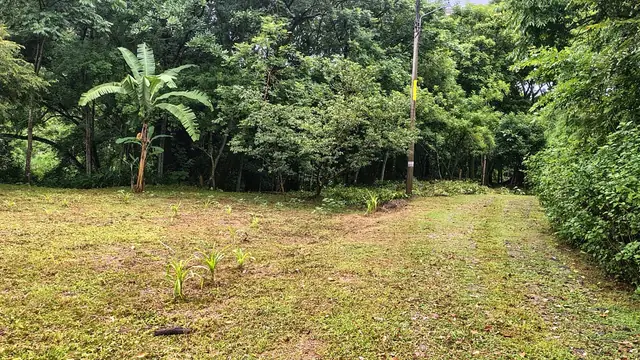
None of that applies inland. A lot in the Central Valley is ordinary titled property: it has a registration number at the National Registry, a registered survey plan, and an owner who can be a foreigner from day one.
Do you need residency to buy?
No. Buying property and immigration status are separate matters. You can buy as a tourist and own the land while you live abroad. Owning land does not, by itself, give you the right to live in Costa Rica.
If you want to stay long term, the General Law of Migration (Law 8764) lists investors, retirees with a pension (pensionados) and people with a stable income (rentistas) among the temporary-residence categories in Article 79. Temporary residence is granted for up to two years and can be renewed. The minimum investment and income amounts are set by law and regulation; the current requirements are published by the Dirección General de Migración y Extranjería. Any residency application must include enrollment in the national health system (CCSS), according to Article 7 of the same law.
Your own name or a company
Title can be held personally or through a Costa Rican company. Both are recorded at the National Registry. Each option has consequences for taxes, inheritance and reporting, in Costa Rica and in your home country. Decide it with a Costa Rican lawyer and your home tax adviser before the deed is signed, not after.
Three common myths
- "Foreigners can only lease land." Not inland. Titled land can be owned outright by a foreigner.
- "You need a Costa Rican partner." A foreigner can buy titled inland land directly, in their own name. The limit on companies owned mostly by foreigners appears in the coastal-zone law, for concessions.
- "Buying property gives you residency." Only through the investor category, with its own minimum and its own application.
What a foreign buyer should check
Being a foreigner does not change the checklist, but buying from abroad makes it more important to follow it in writing.
| Check | Where | Why it matters |
|---|---|---|
| Owner, liens and annotations | Certification from the National Registry | Confirms who can sell and whether there are mortgages or pending entries |
| Registered survey plan | Registry cadastre | Shows boundaries and area; it should match the land you walk |
| Land-use certificate | The municipality | Says what the zoning allows (Law 4240, Article 28) |
| Municipal taxes | The municipality | Avoids inheriting unpaid property tax |
| Forest and river limits | Forestry Law 7575 | Protection strips along rivers and limits on land-use change in forest |
The full sequence is in our step-by-step guide to buying land in Costa Rica, and the registry and escrow details are in how to buy land in Costa Rica safely.
Taxes are the same for foreigners
Costa Rica does not charge foreigners a different rate. The transfer tax is 1.5% (Law 6999, Article 8), calculated on the real value of the transaction, and the law names buyer and seller as taxpayers in equal parts (Article 6), so your contract should state who pays what. After the purchase, the property tax is 0.25% a year on the value registered with the tax administration (Law 7509, Article 23), paid to the municipality.
Practical tips for buying from abroad
- Hire your own lawyer and notary. In Costa Rica the notary formalizes the deed; make sure someone reviews the documents for you, not only for the seller.
- Visit, or ask for a live video walk. Compare what you see with the survey plan: corners, access road, river banks, slopes.
- Move money through banks. Expect to document where the funds come from; Costa Rica's anti-money-laundering law requires it.
- Ask what cannot be confirmed yet. Price, zoning or utility connections may need a written answer before you commit.
At Finca Valle Verde in Atenas, for example, the seven lots are titled, each one has its own registered survey plan, and a buyer's lawyer can verify them at the National Registry before anything is signed. You can see them on the lots page.
Sources
- Political Constitution of Costa Rica, Articles 19 and 45 (SCIJ)
- Law 6043, Maritime-Terrestrial Zone, Articles 9, 10 and 47 (SCIJ)
- Law 8764, General Law of Migration, Articles 7 and 79 (SCIJ)
- Dirección General de Migración y Extranjería: residency procedures
- Law 6999, Real Estate Transfer Tax, Articles 6 and 8 (SCIJ)
- Law 7509, Property Tax, Article 23 (SCIJ)
- Law 4240, Urban Planning, Article 28 (SCIJ)
- Law 7575, Forestry Law (SCIJ)
- National Registry of Costa Rica
Last reviewed 2026-11-18.