
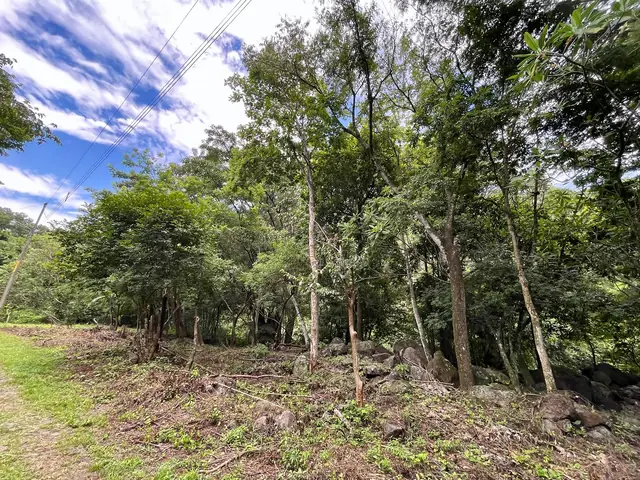
Atenas weather: what the official data says
You will hear that Atenas has "the best climate in the world". That is a local nickname, not a measurement. What Costa Rica's National Weather Institute (IMN) does say is that the lower western Central Valley, naming Atenas, Turrúcares, La Garita and Guácima, has a "dry climate with a strong Pacific influence" (IMN, Central Valley climate, in Spanish).
The closest official station with published records is at Juan Santamaría International Airport (SJO). From 2010 to 2025 it logged:
- Average high: 31.2 °C (about 88 °F) over the year.
- Average low: 16.7 °C (about 62 °F). Average lows stay between 15.7 and 17.4 °C (60–63 °F) in every month.
- Rainfall: about 1,975 mm (78 inches) a year, on roughly 185 days.
Source: IMN, Juan Santamaría Airport climatology, in Spanish. In plain terms: warm days, cool nights, no winter coats and little use for heating. The Pacific influence shows up in the wind: from May to November a sea breeze from the south and southwest blows from mid-morning to late afternoon, while December to March brings steady trade winds from the east.
These figures come from the airport station, the nearest official reference. Conditions on any given property vary with elevation and terrain.
Dry season and rainy season
Costa Ricans call the dry season verano (summer) and the rainy season invierno (winter), even though they do not match northern seasons. Here is how the year runs, using IMN averages:
| Season | Months | What to expect |
|---|---|---|
| Dry season | December to March | Very little rain: January to March average 4–15 mm (under 0.6 in) a month, on about 3 days. |
| Transition | April | First showers (about 115 mm, 4.5 in). The hottest month, with an average high of 33.1 °C (92 °F). |
| Rainy season | May and June | Rains set in during the second half of May: 260–295 mm (10–11.5 in) a month. |
| Mid-year dry spell | July and August | Called veranillo: less rain and more wind, 175–220 mm (7–8.7 in) a month. |
| Wettest months | September and October | 330–350 mm (13–13.8 in) a month, with rain on about 26 days. |
| Transition | November | Rain tapers off toward the dry season. |
Any month works for a visit. If you plan to build, the dry season is the easiest time to start earthwork.
Healthcare near Atenas
Costa Rica's public health system is run by the CCSS, known locally as la Caja (ccss.sa.cr). Primary care happens at neighborhood clinics called EBAIS, grouped into health areas, and Atenas has its own health area. Hospitals handle specialists, surgery and emergencies.
Drive times from the property, without traffic (OSRM route calculation, November 13, 2026):
- Hospital San Rafael de Alajuela (CCSS, public): 19–33 minutes.
- A private hospital in Escazú: 27–31 minutes.
- Emergencies: dial 9-1-1 anywhere in the country (911.go.cr).
If you apply for residency, immigration law requires you to enroll in the CCSS, and the monthly contribution depends on your income. Residency categories for retirees (pensionado), people with fixed income (rentista) and investors are set by the immigration authority (DGME), which publishes the current income requirements. A Costa Rican lawyer can tell you which category fits. Our guide on pensionado residency covers the basics.
Getting around
| Destination | Drive time |
|---|---|
| Juan Santamaría International Airport (SJO) | 21–31 min |
| Downtown San José | 34–40 min |
| Port of Caldera | 58–65 min |
| Herradura and Jacó beaches | 1 h 20 – 1 h 25 |
The property sits near Route 27, the toll highway from San José to the Pacific port of Caldera, so the airport and the beach are both easy day trips. Expect longer times at rush hour and on holiday weekends. Directions and a map are on the location page.
Daily life in Atenas
Atenas is a small, unhurried town with a farming past; the municipality's own history recalls oxcarts hauling coffee. According to the municipality's history of the canton, its first name was "Río Grande", after the river that runs through it; it was called Sabana Larga from 1788, took the name Atenas in 1833, became a canton in 1868 and a city in 1918.
Downtown you will find the municipal office (on the west side of the central park), shops, banks and pharmacies. Larger shopping, government offices and specialists are in Alajuela and the San José metro area, all under an hour away. Day-to-day life runs in Spanish, so a few lessons before you arrive pay off quickly.
The Municipality of Atenas handles what matters most once you own land: building permits, the annual property tax, the land registry for the canton and business licenses.
Costa Rica as a whole keeps showing up in retirement rankings: International Living's 2026 Global Retirement Index placed it third in the world (The Tico Times).
Before you build
- April heat: deep roof overhangs, cross-ventilation and shade trees keep a house comfortable without much air conditioning.
- September and October rain: plan drainage for the lot and the roof for heavy downpours.
- Dry-season wind: keep it in mind for windows, roofs and terraces.
- Utilities: at Finca Valle Verde there is power with street lighting, private well water with lab tests, and internal roads. Hookups for each lot and internet service: ask us.
For a broader look at retiring here, read Retire in Atenas, Costa Rica. To see a real piece of land, browse the 7 lots at Finca Valle Verde or ask for a live video walk-through on WhatsApp.
Sources
- IMN: Central Valley climate (Spanish)
- IMN: Juan Santamaría Airport climatology, 2010–2025 (Spanish)
- Municipality of Atenas: history of the canton (Spanish)
- Municipality of Atenas (Spanish)
- CCSS, Costa Rica Social Security Fund (Spanish)
- Immigration authority (DGME): residency (Spanish)
- 9-1-1 Emergency System (Spanish)
- The Tico Times: Global Retirement Index 2026
Last reviewed 2026-11-18.